Pediatricians, dietitians, coaches, and GLP-1s: all in one program
Unlimited support for your teen, all on your family’s schedule. Our program combines unlimited access to specialists, customized care plans, home monitoring + labs, and medication to ensure your teen is set up for success and a long-term, health focused lifestyle.
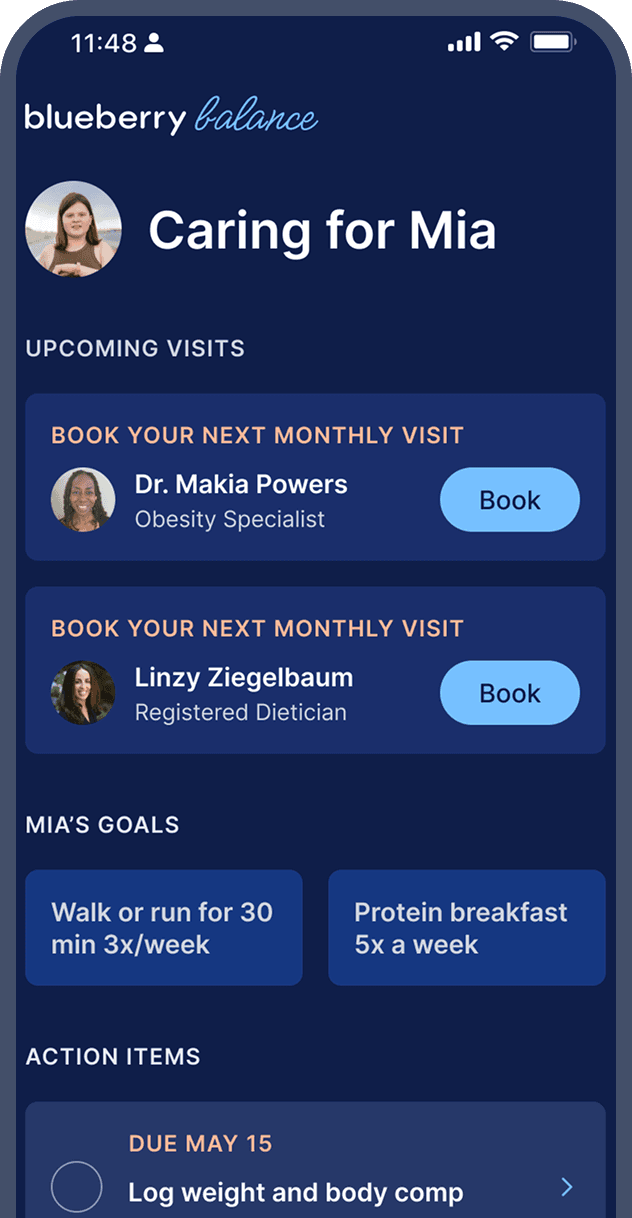
A fully connected, virtual care team
Balance is a virtual, subscription-based program. Every family gets a fully dedicated care team — and GLP-1 medication is one tool inside that model.

Pediatric obesity doctor
Board-certified pediatrician with obesity-medicine certification (DABOM). Guides diagnosis, prescription, and ongoing monitoring.
Registered dietitian
Nutrition support, family meal coaching, and behavior change — included in the membership, not an add-on.
Health coach
Sustainable movement and habit plans built for a teen's life — not an adult gym.
Care between visits
Secure messaging, monthly check-ins, and labs reviewed by your doctor.
The Blueberry Balance care model
We walk you through a stepped-care model, so you and your teen always know where you are in the process.
PHASE 1 · WEEKS 1-2
Intake
First visit with the pediatric obesity doctor. Behavioral and psychological intake. Initial session with your dietitian. Labs ordered if not already done.
Phase 2 · Months 1–3
Intensive
Monthly doctor visits, monthly dietitian sessions, and health coach sessions as needed. GLP-1 titration begins if prescribed, and only after labs and the specialist's review. Messaging between visits to troubleshoot side effects, food challenges, and momentum.
Phase 3 · Months 4–6
Stabilization
Monthly visits continue. Maintenance dose verified. Labs repeated at month 6 to confirm response and ensure your child remains on track.
Phase 4 · Months 7–12+
Maintenance
Lower-touch monthly check-ins, quarterly doctor visits, and group dietitian sessions when helpful. We plan a transition to long-term maintenance at month 12.
16.1%
Source: STEP TEENS study (Weghuber et al., NEJM 2022)
The trial paired medication with lifestyle counseling, which is also how Balance works. Your teen's results will depend on many factors, and your doctor will set expectations specific to them.

Ongoing Lab Testing: Know exactly how GLP-1s are helping your teen
Lab tests help us understand each teen's metabolic baseline before starting. We also use 10+ lab tests to monitor how GLP-1s are affecting your teen's body to monitor safety along the journey. Labs are included with your Blueberry Balance membership.
How it works
We send a lab order to Quest Diagnostics. Your doctor reviews the results with you once the labs are available. Repeat labs are typically drawn at month 6, with adjustments based on your teen's needs.
LABS INCLUDED WITH MEMBERSHIP
Lipid panel
A cardiovascular risk reading.
HbA1c
A measure of average blood sugar over three months.
Liver function tests
Commonly looked at in metabolic care because the liver is often affected.
Kidney function tests
A baseline reading on kidney function.
Serum lipase
A baseline reading the specialist uses for context if abdominal symptoms come up later.
We monitor your teen as a whole person, not just a number on the scale
Weight, mood, and how a teen feels about their body are all connected. So we monitor it all with validated mental-health and disordered-eating screeners, completed at the first clinical visit and reviewed by your specialist.
Physiology
A brief check across emotions, attention, and behavior.
Depression
Looks at quiet shifts in mood, energy, and self-esteem.
Anxiety
Measures worry, restlessness, and nervousness.
Eating disorder
Questions that flag eating concerns early, before they grow.
Lifestyle
To get a clear picture of the habits already in place as we build on them.
Sleep
Screens for sleep-related patterns that can quietly affect mood, focus, and growth.
Why do we screen for mental health?
Disordered eating, anxiety, and low mood are common alongside metabolic concerns — and GLP-1 care works best when we treat the whole teen. Screening at intake means we catch what matters early, loop in the right support, and check in again as we go. If a screener raises a concern, your specialist talks it through with you directly.
Is Balance right for your teen?
A board-certified pediatrician with expertise in obesity medicine reviews each application — and we'll tell you when another level of care is more appropriate.
To enroll, your teen needs to be:
Between ages 12 and 17
A resident of Florida, Texas, Arizona, Michigan, Illinois, New Jersey, New York, California, or Colorado (more states coming)
At or above the 95th percentile BMI for age and sex — the clinical threshold for pediatric obesity
Clinically appropriate for medical management of obesity — reviewed by a pediatric obesity specialist
Not currently covered by Medicaid (Balance isn't available to Medicaid-covered teens yet)
Balance may not be the right fit if your teen has:
Some are medical contraindications to GLP-1 medication; for others, a different level of care is safer or more appropriate first.
A personal or family history of Multiple Endocrine Neoplasia type 2 (MEN 2), medullary thyroid carcinoma (MTC) or other thyroid cancer, or tumors affecting multiple hormone-producing glands
Type 1 diabetes, or regular insulin use (teens with type 2 diabetes are in scope, since GLP-1s are used to treat T2D)
A history of pancreatitis, or a hospitalization for severe abdominal pain related to the pancreas
Active or unstable cardiac disease
Pregnancy, planning pregnancy, or breastfeeding
An active eating disorder, such as anorexia or bulimia
Active severe depression, active suicidal ideation, or an untreated severe mood disorder
Any behavioral concerns that would limit a teen's ability to participate in and engage with the care team
GLP-1 medications carry serious safety considerations.
GLP-1 medications carry serious safety considerations, including a boxed warning about thyroid C-cell tumors. Balance does not prescribe these medications if you or your teen has a personal or family history of medullary thyroid carcinoma (MTC) or Multiple Endocrine Neoplasia syndrome type 2 (MEN 2). Talk to a clinician before starting if your teen has a history of pancreatitis, gallbladder disease, kidney problems, an active eating disorder, or a serious allergic reaction to a GLP-1.
This is a summary, not the full safety information. Read the full Important Safety Information before starting Balance.